

An ABS or EBS warning lamp stays on. The fault code points to a wheel speed sensor. You fit a new sensor, and the lamp comes back a week later.
It is one of the most common and most frustrating faults in a commercial vehicle or trailer workshop. The reason is simple: a wheel speed sensor fault code tells you the ECU is not getting a good signal from one wheel. It does not tell you why.
This guide shows you how to test ABS/EBS wheel speed sensors properly, how to tell a sensor fault from a wiring fault, and when a dedicated speed sensor tester will save you hours.
The quick answer
A wheel speed sensor fault can come from the sensor, the harness, the connector, the tone ring, the air gap or the ECU. To find the real cause, work through the circuit in zones:
- Read the fault codes and note which wheel is affected
- Inspect the sensor, tone ring, connector and harness
- Test the sensor on its own
- Test the wiring between the sensor and the ECU
- Check the ECU’s response to a known good signal
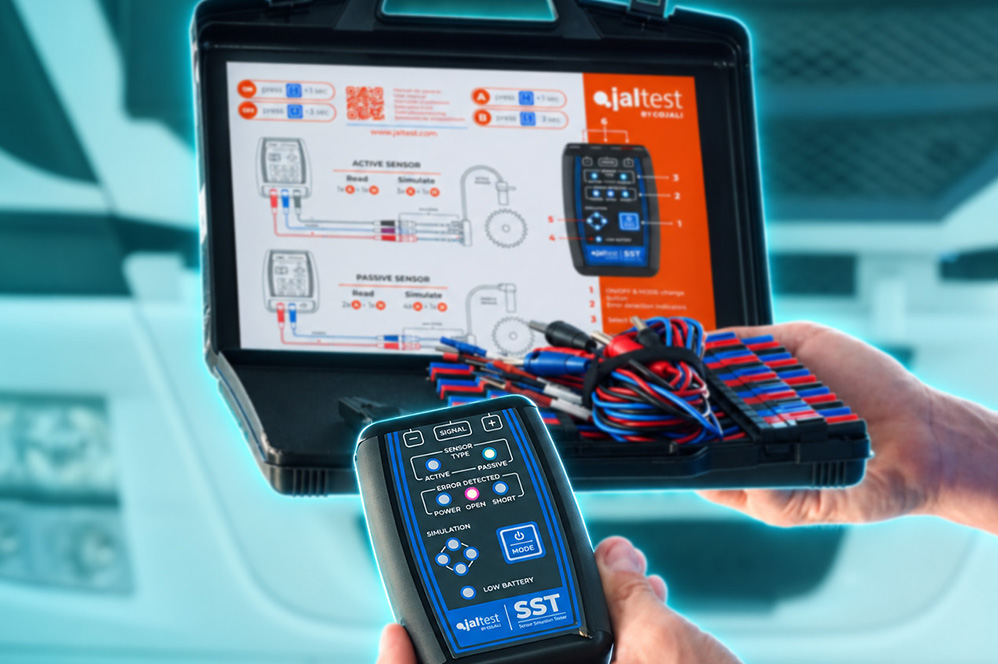
A dedicated tool such as the Jaltest SST Speed Sensor Tester is designed to help you separate these zones quickly, so you replace the right part first time.
What does a wheel speed sensor do?
ABS and EBS rely on wheel speed signals to detect when a wheel is about to lock under braking. Each monitored wheel has a sensor that reads a toothed tone ring turning with the wheel. The ECU or modulator compares those signals and reduces brake pressure at the wheel that is slowing too quickly.
There are two main types of sensor:
Passive (inductive) sensors generate their own AC signal as the tone ring teeth pass the sensor. The signal gets stronger as the wheel speeds up, and weaker as the gap between sensor and tone ring grows. That is why air gap matters so much.
Active sensors, often Hall effect types, are powered by the system. Their output does not depend on wheel speed in the same way, so they can keep reporting wheel movement at very low speeds.
Both types can fail in similar ways, but they are tested differently, which is one reason a technician can lose time chasing the wrong fault.
Symptoms of a wheel speed sensor or wiring fault
Watch for these common signs:
- An ABS or EBS warning lamp on the dash, or on the trailer
- A stored fault code for one wheel, such as no signal, implausible signal or open or short circuit
- Reduced or lost ABS function, where the vehicle brakes conventionally without anti lock protection
- Intermittent warnings that appear after washing, in wet weather or over rough roads, which often point to wiring or connector trouble
- Unwanted ABS intervention at low speed, which can indicate an erratic signal
- Faults that appear after wheel end work, such as a bearing or brake overhaul, where a sensor may have been disturbed or a tone ring damaged
It is worth fixing these promptly. ABS and EBS warning lamps are checked as part of the annual test, and enforcement of ABS and EBS faults can differ, with EBS defects treated more strictly. Check the latest DVSA guidance for the details that apply to your vehicles.
Why replacing the sensor does not always fix it
A sensor is only one link in the chain. If the fault code returns, the real problem is often one of these.
Sensor side
- A damaged or contaminated sensor tip
- An internal break in the sensor coil
- An air gap that is too large, for example from a sensor pushed back, a broken retaining clip or a loose wheel bearing
- A cracked, corroded or damaged tone ring
Wiring side
- Chafed or fractured cable, often at a flex point near the hub or axle
- Corroded or loose connector pins
- Water in the connector
- A short to ground or supply, or an open circuit
System side
- A fault in the ECU or modulator channel
- A power supply problem, especially on trailers, where ABS and EBS are normally powered through the ISO 7638 connector
If you only test the sensor, a wiring or tone ring fault will keep sending you back to the same wheel.
How to test an ABS/EBS wheel speed sensor, step by step
Always follow the vehicle or system manufacturer’s procedure and specifications. Values and methods vary between makes and systems.
Step 1: Read the fault codes
Connect your diagnostics and read the stored faults. Note the wheel position, the type of fault and whether it is active or intermittent. If your diagnostics support it, check live wheel speed data while the wheel is turned or the vehicle is rolled.
Step 2: Inspect everything you can see
Look at the sensor head, its retaining sleeve or clip, the harness routing and the connector. Check the tone ring tooth by tooth for cracks, damage and corrosion. Look for signs of rubbing, heat damage or water ingress.
Step 3: Check the mounting and air gap
For passive sensors especially, the gap between the sensor and tone ring has a big effect on signal strength. A loose wheel bearing can let that gap vary, which can cause a fault code or false activation. Refit the sensor using the manufacturer’s method, and use a non magnetic feeler gauge where a measured gap is specified.
Step 4: Test the sensor itself
For passive sensors, a resistance check against the manufacturer’s specification will show a failed coil, and an AC output check while the wheel turns will show how strong the signal is. Active sensors need the correct supply and signal checks. A multimeter can help with these basics, but it only gives you a snapshot.
Step 5: Test the wiring
Check continuity, and test for shorts to ground and supply. Wiggle the harness and connector while you monitor the signal, as many faults only appear when the cable moves. Remember that a sensor that tests well at the sensor end can still look faulty at the ECU if the harness is damaged.
Step 6: Use a swap test
If the vehicle allows, swap the suspect sensor with a good one on the same axle and see where the fault goes. If the fault follows the sensor, replace the sensor. If it stays with the original wheel position, suspect the wiring, connector, tone ring or ECU channel.
Step 7: Clear the faults and confirm the repair
Clear the codes, road test or roll test the vehicle, and read the faults again. Never assume the job is finished until the lamp stays off and no fault returns.
When a multimeter is not enough
A multimeter is useful, but sensor signals change with speed, and intermittent faults can disappear as soon as you stop to measure them. An oscilloscope shows more, but it takes time to set up and experience to read.
That is where a dedicated tester earns its place in the workshop. Jaltest describes its SST as giving a quick, visual way to check a sensor signal, rather than a more involved test with a multimeter or oscilloscope.
Jaltest SST: isolating the sensor from the wiring
The Jaltest SST Speed Sensor Tester is a small, portable device designed to check the correct operation of speed sensors, and it is built around exactly the problem in this article: finding out which part of the circuit is at fault.
According to Jaltest, it:
- Tests both active sensors (such as Hall effect types) and passive sensors (such as inductive types)
- Has two operating modes, covering tests of both the sensor and the ECU it is connected to
- Can detect short or open circuit faults
- Simulates sensor signals, so you can verify the wiring harness, the connector and the ECU
- Fits all sensor connectors
- Gives a visual indication of the sensor signal output using LEDs
- Weighs around 180g and measures 118 x 79 x 32mm, so it fits in a toolbox or a mobile technician’s van
In practice, that lets you work in three zones:
- At the sensor: test the sensor directly to see whether it is producing a good signal
- Through the harness: test from the other end of the wiring to see whether the signal survives the journey
- At the ECU: simulate a signal to see whether the ECU responds correctly
When the fault shows up in one zone and not another, you know where to look, and you avoid replacing parts that were never broken.
The SST is designed for commercial vehicles, trailers, buses, light vehicles, agricultural machinery and material handling equipment, and Jaltest positions it as a companion to Jaltest Diagnostics.
Jaltest Tools also come with an included Jaltest warranty, and orders placed with Eclipse by 1pm are despatched for delivery the next working day.
Start with a reliable connection
Testing is only as good as the connection behind it. If you are reading faults and live data, you need the right Jaltest cable for the vehicle in front of you. Eclipse supplies cables to suit a wide range of vehicles, so check you have the correct one before you start.
Diagnostics that cover the whole braking system
Wheel speed sensors are only part of the story. Fault codes, live data and system tests all help you decide whether the problem is the sensor, the wiring or something else in the braking system.
- The Jaltest Trailer package is built to diagnose and repair ABS/EBS systems across brands such as Knorr-Bremse, Haldex and Wabco
- The Jaltest Commercial Vehicle package covers trucks, trailers, buses and light commercial vehicles, with a large and growing list of brands and models
- Operators of coaches and buses can look at the Coach and Bus package
- For Knorr-Bremse systems, the Knorr-Bremse Diagnostics add on offers more advanced diagnostics
To find out how the diagnostics fit with other brake tools, see the Jaltest WST Wear Sensor Tester for brake pad wear sensors.
You can learn more about Jaltest diagnostics on the Jaltest website, and see how Eclipse supports technicians with training courses and technical support.
How to prevent repeat sensor faults
A few good habits reduce repeat faults and comebacks:
- Check tone rings whenever the wheel end is apart
- Refit sensors and retaining sleeves using the manufacturer’s method
- Route and secure harnesses away from moving parts and heat
- Protect connectors from water, especially after washing
- Test the ABS or EBS warning lamp sequence as part of routine inspections
- Record the fault, the test results and the repair, so patterns show up over time
Frequently asked questions
What causes an ABS wheel speed sensor fault on a truck or trailer?
Common causes include a damaged or contaminated sensor, a wrong air gap, a damaged tone ring, a chafed cable, a corroded connector or a fault in the ECU or modulator. Wheel bearing play can also change the air gap and cause signal problems.
How do I tell if it is the sensor or the wiring?
Test in zones. Check the sensor on its own, then test through the harness, then check how the ECU responds to a known signal. A swap test can also show whether a fault follows the sensor or stays with the wheel position. A tester such as the Jaltest SST is designed to help you do this faster.
Can I test a wheel speed sensor with a multimeter?
Yes, for basic checks such as resistance on passive sensors, continuity and supply. However, a multimeter only gives you a snapshot, and it can miss intermittent faults and signal quality problems.
What is the difference between active and passive wheel speed sensors?
Passive sensors, such as inductive types, generate their own AC signal, which grows stronger with wheel speed. Active sensors, such as Hall effect types, are powered and produce a signal that does not depend on wheel speed in the same way, so they can detect movement at very low speeds.
Can I keep driving with an ABS or EBS wheel speed sensor fault?
A warning lamp means the system may not be working fully, so the fault should be investigated and repaired promptly. Operators also risk enforcement action if a warning lamp is found, so check the latest DVSA guidance.
Will an ABS fault fail an annual test?
The operation of ABS and EBS warning lamps is checked as part of the annual test, and a lamp that indicates a malfunction can lead to a failure. Check the current DVSA inspection manual for the exact criteria.
Does the Jaltest SST work on trailers?
Yes. Jaltest lists commercial vehicles, trailers and buses among the applications for the SST, along with light vehicles, agricultural machinery and material handling equipment.
Fix ABS/EBS faults faster
If you are tired of replacing sensors that were never the problem, a proper test process and the right tools make a real difference.
Explore the Jaltest SST Speed Sensor Tester in the Eclipse eShop, or speak to our team about the right diagnostics package for your workshop or fleet. Call 03454 666 699 or get in touch with Eclipse and we will help you find the right solution.